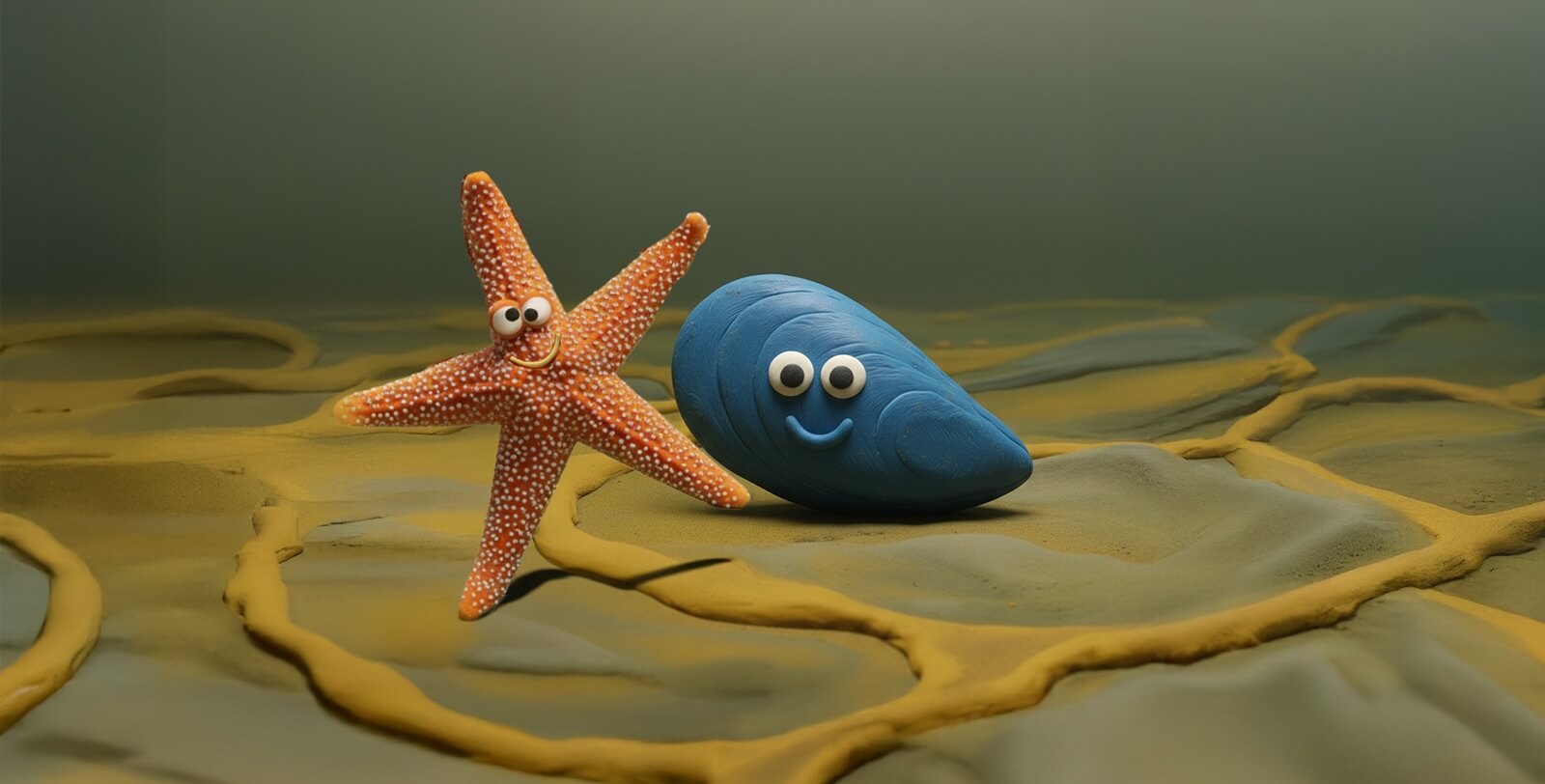
At Coolbox Films, we’re always exploring how emerging tools can enhance, rather than replace, human creativity. Having previously produced both traditional stop-motion animation and AI-generated films, our next challenge felt like a natural evolution: could we combine AI and stop motion to create a film that still captured the charm, tactility, and warmth of handcrafted animation?
That question arrived at exactly the right moment, when we were approached by Sussex Kelp Recovery Project, a charity dedicated to restoring vital underwater ecosystems along the Sussex coast. They wanted a festive Christmas film that also told a meaningful environmental story.
The result was 12 Days of Kelpmas – a playful, underwater journey showing how marine life returns when kelp forests are given the chance to recover.
The film opens on a barren seabed: empty, muted, and lifeless. With each passing day, sugar kelp begins to grow and marine creatures slowly return. By day twelve, the ocean floor is transformed into a thriving ecosystem filled with colour, movement, and biodiversity – all driven by kelp restoration.
This narrative arc was central to the film’s emotional impact. It allowed us to clearly show how small environmental changes can lead to powerful ecological recovery, while keeping the tone light, festive, and accessible.
As with any successful animation project, storyboarding was essential. It allowed us to plan timing, movement, and continuity across every scene, acting as a visual blueprint for the entire production.
Defining the opening and closing shots early proved particularly important:
The opening needed to feel stark and empty
The final scene had to burst with kelp and marine life
Locking these moments early gave us clear visual anchors and ensured consistency throughout the animation process.

AI tools such as Whisk and Flow helped us generate and explore visual possibilities quickly, but the rhythm, storytelling, and emotional tone were always guided by human judgement.
Accuracy mattered just as much as style. A key example was the kelp itself: it needed to be native to Sussex, specifically sugar kelp. Achieving this required extremely precise prompt control and reference imagery. Once we achieved a strong AI output, we refined it further in Photoshop to perfect the final look.
Each marine creature needed to feel expressive, friendly, and authentic to Sussex waters. Some designs were more challenging than others.
Sea bass, for example, can quickly become unintentionally terrifying in plasticine-style animation due to their large eyes. AI also tends to generate overly symmetrical eyes, which can feel robotic or emotionally flat. By subtly adjusting pupil position – nudging them slightly inward and upward – we gave the characters warmth and connection, helping them feel alive and engaging as they look back at the viewer.
This careful balance of prompt refinement and human visual judgement kept the characters charming rather than alarming.

Once designs were approved, we brought the characters to life through movement. Each still frame acted as a stepping stone, allowing motion to flow naturally from one moment to the next.
Flow was used to animate the in-betweens, with extensive prompt-tuning to balance:
Character actions (giggling crabs, swaying starfish, popping anemones)
Cinematic direction (subtle camera moves and crash zooms)
Throughout, consistency was critical: no visual glitches, no unexpected creatures, and the correct number of animals in every scene.
As expected, the animations rarely worked perfectly first time. Iteration was key. One small example: it took over 80 video generations to get the dolphins right. Twelve dolphins versus AI – patience won.
The final result was a 60-second plasticine style animation delivered in just seven days. By combining AI-assisted workflows with traditional animation principles, we dramatically accelerated production:
Traditional stop motion: 8-12 weeks
Conventional motion graphics: 4-6 weeks

The finished film was warmly received across social media:
Instagram: 11,000+ views with a 4.7% engagement rate
LinkedIn: 11.7% engagement from 517 views
These results reinforced the value of using AI as an exploration and acceleration tool, while relying on human decision-making for storytelling, performance, and emotional nuance.

Overall, 12 Days of Kelpmas demonstrates how AI can support creative exploration without compromising character, warmth, or narrative integrity. By combining emerging technology with hands-on craft, we created a film that feels playful, tactile, and emotionally resonant – while remaining efficient and light-touch in its production.
If you’re curious about how AI-assisted animation can elevate your next film, get in touch with Coolbox Films – we’d love to explore what’s possible together.